No CEO wants to be the one who cannibalizes their own business. Nearly all of them are watching a competitor do it anyway. That’s the paradox at the center of today’s business environment. And once you notice it, it’s hard to stop seeing it everywhere: leaders would rather be disrupted than risk disrupting themselves.
For most of modern business history, that trade-off wasn’t necessary. Find a market opportunity, build a value proposition around it, spend years refining the formula. Growth meant more market share, tighter margins, better execution of a model that already worked.
That playbook is running out of runway. AI, shifting labor markets, changing customer expectations, geopolitical shocks- none of these are new on their own. What’s new is that they’re hitting at the same time, compounding each other, in a way most organizations weren’t built to handle.
The Hidden Assumption Behind Modern Management
Underneath most strategic plans sits a quiet assumption: tomorrow will look a lot like today. Nobody says it out loud, but it shows up everywhere, in annual budgets, in performance reviews, in org charts built around specialization instead of speed. There’s a reason for it. Betting that the future resembles the past is simply safer. It’s close to human nature to protect the version of the business that’s already working.
That instinct made sense when markets moved in decades, not quarters. The command-and-control hierarchy most companies still run on was built for exactly that world: long cycles, predictable change, efficiency as the highest virtue. The problem is what happens when the world stops cooperating. Structures built for stability don’t bend easily. They slow down right when speed matters most.
Why Disruption Is More Dangerous Than Leaders Realize
Most executives treat disruption as a set of separate problems: AI is a technology issue, labor shortages are an HR issue, tariffs are a supply-chain issue. Treating them separately is the mistake. The real risk isn’t any one force on its own; it’s how they feed each other.
Take Salesforce and HubSpot. Fifteen or twenty years ago, they were the disruptors, the ones who built the SaaS model and made a fortune doing it. Now they’re the incumbents, sitting on office towers in cities around the world and payrolls in the tens or hundreds of thousands. That cost structure used to be an asset. It’s increasingly a liability, because AI is making it cheap and fast to build custom, in-house alternatives to what they sell. Some people are already calling it the “SaaSpocalypse.”
The same pattern shows up in the numbers elsewhere. Ford’s total market cap today is roughly where it was in 2017. Tesla, meanwhile, trades at ten to twenty times that. In accounting, the SaaS and platform companies building tools for accounting firms are commanding something like 20 times EBITDA (Earnings Before Interest, Taxes, Depreciation, and Amortization), while the accounting firms themselves are worth closer to two- or three-times revenue. The money hasn’t left either industry. It’s moved to whoever is closest to where the value is actually being created now.
That’s the trap. The businesses most exposed to disruption are often the ones doing best right now. Strong margins and loyal customers breed confidence, and confidence is exactly what keeps a leadership team from questioning the model underneath it. By the time the hard questions get asked, the opportunity is usually gone.
The Organizational Resistance to Change
Some of this comes down to how companies are built. Most leadership teams are organized into silos, marketing understands marketing, ops understand ops, and almost nobody owns a full view of how the business actually makes money, or where it’s exposed if a core assumption stops holding.
That blind spot starts at the top. Roughly 70% of CEOs say disruption is a genuine threat to their business. Their own executive teams feel it less: closer to 60-70% report that same urgency, which means a meaningful share of the leadership team isn’t nearly as worried as the person who has to answer to the board.
One story from the episode sums up how this plays out in practice. A client came in and said, flatly: “We know we’re being disrupted. We don’t know how to fix it.” The advice back was that almost every company gets stuck at the same stage. Agreeing there’s a problem is easy. Figuring out which assumptions no longer hold takes real work, but it’s doable. What almost nobody manages is step three: building a system that lets the business actually move fast enough to respond. Recognizing disruption was never the hard part.
From Transformation to Continuous Adaptation
The old model for change was a big, occasional reset: identify a problem, launch an initiative, redesign the org chart, land on a new operating model three to five years later. That only works if the destination stays put long enough to be worth the trip. Increasingly, it doesn’t.
What’s needed instead looks more like a habit than a project: testing assumptions about customers, competitors, and where value is moving on an ongoing basis, rather than once a year at a strategy offsite. Efficiency still matters. It’s just no longer the only thing that matters. In an unstable environment, speed is its own kind of advantage.
The New Leadership Imperative
Asked what he’d tell a company trying to think more like a challenger than an incumbent, one guest gave three answers, in order. Educate the leadership team and the board, not just the CEO, because a CEO who gets it while everyone else doesn’t is still operating alone. Challenge every assumption the business runs on: who the real competitors are, how customers actually behave, where value is being created. And build the operational muscle to act on what you find, which sometimes means moving on from people who can’t help build what’s next, regardless of how well they’ve served the business up to now.
That last point is uncomfortable, and it comes up more than once in the conversation. The people who got a company to where it is today aren’t automatically equipped to take it where it needs to go next. It isn’t about effort. It’s about whether someone can help build new value, or only protect the old kind.
Opportunity in an Unstable World
One useful way to think about all this is disruption as a ladder, not a cliff. The first rung is survival; do we make it through at all? The second is whether the business is capturing its fair share of the value in its category (Ford vs. Tesla, again). The third and highest rung is building something that can keep finding and capturing new value as it emerges, instead of only defending what it already has.
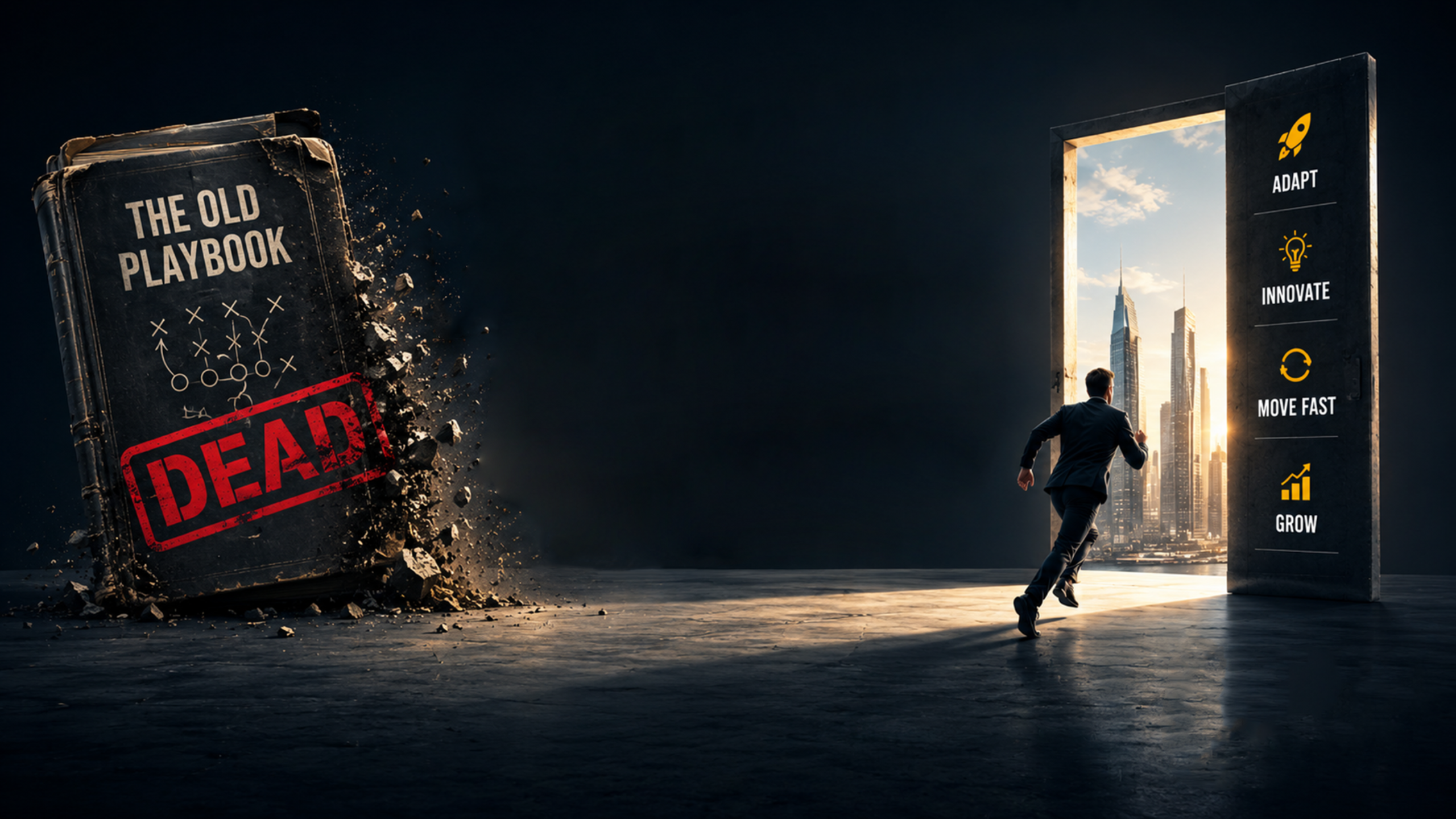
The companies that win the next decade won’t be the ones that optimized the hardest. The old playbook, find what works, make it more efficient, scale it, still has value. It’s just not enough on its own anymore. What matters now is whether a business is willing to question its own assumptions before someone else forces the issue.
The businesses most exposed to disruption are often the ones doing best right now.
This podcast explores why confidence in a working model is exactly what keeps leadership teams from questioning it, and how to shift from occasional “transformations” to a habit of continuous adaptation.
▶️ Watch the episode to learn how to turn disruption into a competitive advantage.
Listen to “The Insurgent Mindset” podcast on Apple, Spotify, and YouTube.
Or contact us at mtice@insurgencegroup.com for more information.