
By Rondo Moses | November 2026
Could PepsiCo be worth more in pieces than it is whole? The market has been raising that uncomfortable question for months. In October, it grew louder. Since its 2023 peak, the company has lost about $80 billion in market value, close to a third of what it was worth. The stock trades at its steepest discount to Coca-Cola in more than 25 years. PepsiCo recently traded at roughly 14 times forward earnings. Coke gets 24. Mondelez, another global snack company, gets 19.
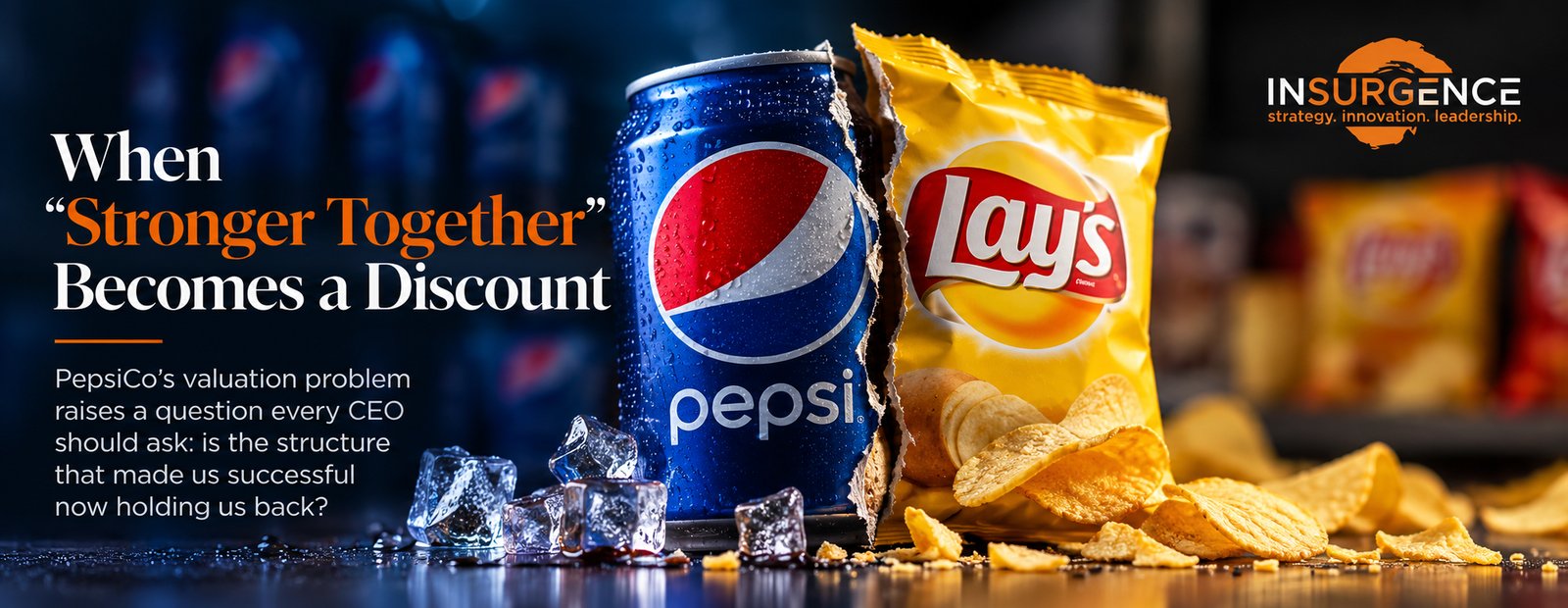
This variance in earnings multiples should unsettle anyone who runs an integrated business. For decades, PepsiCo’s argument has been that having snacks and drinks under one roof makes the company stronger than the sum of its parts. Leadership logic was: shared trucks, shared shelf power, and shared scale. The market is no longer convinced. A discount this steep doesn’t prove the parts would be worth more on their own, since multiples also reflect growth, risk, and capital intensity. But it does raise the uncomfortable possibility: that the individual pieces, unbundled, would be worth more than the company former CEO Indra Nooyi and current Chairman and CEO Ramon Laguarta spent years assembling and defending.
The real issue goes beyond corporate structure. Shared capabilities only create competitive advantage if the benefits they generate outweigh the costs and constraints of keeping the businesses together.
This is not a story about a bad quarter. PepsiCo actually beat estimates in Q3, with organic revenue up 3.1% and core earnings of $2.34 a share. Nor can its problems be explained entirely by weight-loss drugs or consumers trading down to store brands. Both are real pressures, but they don’t fully explain why PepsiCo’s performance and valuation have diverged so sharply from some of its peers.
This is a story about a company whose longstanding structural logic is being called into question. And it is a warning to leaders, regardless of what you sell, because even successful companies can become too attached to structures they have stopped questioning.
Signs of Trouble
As PepsiCo’s North America soft drink sales softened, it cut prices on Lay’s and Doritos by as much as 15%. Despite these cuts, volumes barely moved, so it started raising some of those prices back. It launched several product extensions, including Doritos Protein and SunChips Fiber, to chase the health trend. It spent more on marketing. Laguarta told analysts, plainly, “We’re not competing well in soft drinks.” This year, KFC agreed to drop Pepsi for Coca-Cola across its US restaurants, a switch that starts in January 2027.
Each of those moves is a lever. But none answers the harder question: is the company worth more together than its individual businesses would be apart? A Barclays analyst called the plan “a little bit tactical.” Jefferies asked, on a recent earnings call, “What exactly is the plan?” TD Cowen wrote about “slow progress and lack of transparency.” These analysts see that the fixes keep getting smaller while the problem itself keeps getting bigger.
When a business is in trouble, price cuts, promotions, and product tweaks are familiar responses. They can deliver results without forcing leaders to do the hard work of questioning the assumptions underlying the business. That makes them attractive, even when the deeper strategic question remains unanswered.
At PepsiCo, it took an outside investor to force that deeper question into the public debate. Elliott Management built a roughly $4 billion stake in the company about a year ago and started pressing PepsiCo to streamline, and to consider separating its businesses. A year on, the turnaround still hasn’t delivered, and the hard question Elliott forced is one management had never publicly made a case against.
Four Leadership Lessons
I don’t see the lesson here as “PepsiCo should break up.” The lesson is in the discipline Pepsi skipped, and its relevance for anyone running a multi-unit business that was built to be stronger together.
Regularly challenge your assumptions. Every integrated company rests on beliefs that were once true: that the pieces belong together; that owning the whole business is an advantage; and that scale is a moat. PepsiCo treated those as settled facts rather than open questions. Now the market is questioning whether they still hold. Don’t wait for the market to force the issue. Put your core assumptions on trial at a set time every year, deliberately, when everything is going well. The assumptions underneath your model usually decay slowly, in silence. Audit them before they fail in public.
Assess the full range of available choices. When results stall, the instinct is to reach for short-term, product-level options: Cut a price. Refresh a package. Add a line extension. Those are legitimate moves, but they are at one end of a spectrum that runs through transformational, business-model change. Pepsi defaulted to the incremental end until Elliott pushed it toward the other. The essential discipline is to consider all available options, from a product tweak to a business you buy, build, or shed. Choose based on what the problem actually demands, not on which option is easiest to approve and implement.
Appreciate how hard it is to question what you’ve built. Few leadership teams willingly dismantle the model that made them successful. The integration, the vertical ownership, the “we do all of it ourselves,” stop being strategy and become identity. And identity is the most difficult thing leaders are willing to reexamine. That is why an independent perspective can be so valuable: it challenges assumptions insiders regard as givens.
Accept the near-term costs of reconfiguring for the future. Coca-Cola is an example of a company that chose short-term pain for the sake of its future. Beginning around 2015, Coca-Cola accelerated the re-franchising of its North American bottling operations. Reported revenue declined as the company exited a high-revenue, low-margin business. But the move ultimately produced a more profitable business model, with higher margins and a sharper focus on its brands and concentrate operations. Reconfiguring a business for the future almost always means tough decisions and near-term pain. That pain may be the necessary price of a better long-term result. Incumbents prefer to protect this quarter and defer the cost, which allows costs to compound until someone makes them pay it.
Why breaking up isn’t so obvious
Here is where I’d caution any operator reading Pepsi’s story as a simple case for the breakup. It isn’t.
Breakups are expensive, and their record is mixed. In February, Kraft Heinz looked hard at splitting itself up and then shelved the plan, after new leadership decided the problems were fixable with investment instead. GE offers an instructive counterpoint. It dismantled its sprawling conglomerate into three independent businesses: GE HealthCare, GE Vernova, and GE Aerospace. Since the separation, GE Aerospace and GE Vernova have delivered strong results, while GE HealthCare’s performance has been more mixed. The breakup didn’t guarantee success, but it allowed each business to pursue its own strategy, capital allocation priorities, and operating model. The lesson isn’t that separation always creates value. It’s that the right corporate structure depends on how each business can create the most value.
But PepsiCo isn’t GE. Its snacks and beverages businesses share customers, distribution capabilities, and retail relationships that make the economics of separation more complicated.
PepsiCo’s own business performance complicates the breakup argument. PepsiCo International grew around 8% organically last quarter, its 22nd straight quarter of at least mid-single-digit growth, and, year-to-date, it accounts for 41% of net revenue. And unlike Coke, Pepsi doesn’t have a deep bench of large independent bottlers ready to take its distribution network, which makes the structural move harder to pull off.
So the question isn’t whether PepsiCo should break up. It’s whether management can demonstrate why it shouldn’t. An integrated incumbent owes it to itself to ask that question, rigorously and early. Yet a year into public pressure, PepsiCo has not convincingly communicated how its integrated structure will create greater value. It is cutting prices and raising them; it is reformulating chips; and it is talking about structural change. In Laguarta’s words, the company has been open “to revisiting every option.” But openness to alternatives is not the same as articulating a convincing case for the path chosen. The market doesn’t need PepsiCo to announce a breakup. It needs a convincing explanation of why the businesses belong together and a credible plan to make that logic pay.
The question for your own business
For leaders of integrated businesses, run the test on your organization. Can you explain, in one sentence backed by data, why your segments are worth more together than they would be apart? If you spun off your weakest unit tomorrow, would what’s left trade up or down? Are your last four strategic moves tactical or structural? And who has the clearest view of your value right now, you or someone outside the company who hasn’t told you yet?
Staying insurgent after you’ve won doesn’t mean defending the structure that got you there. It means being willing to take it apart before the market does it for you.