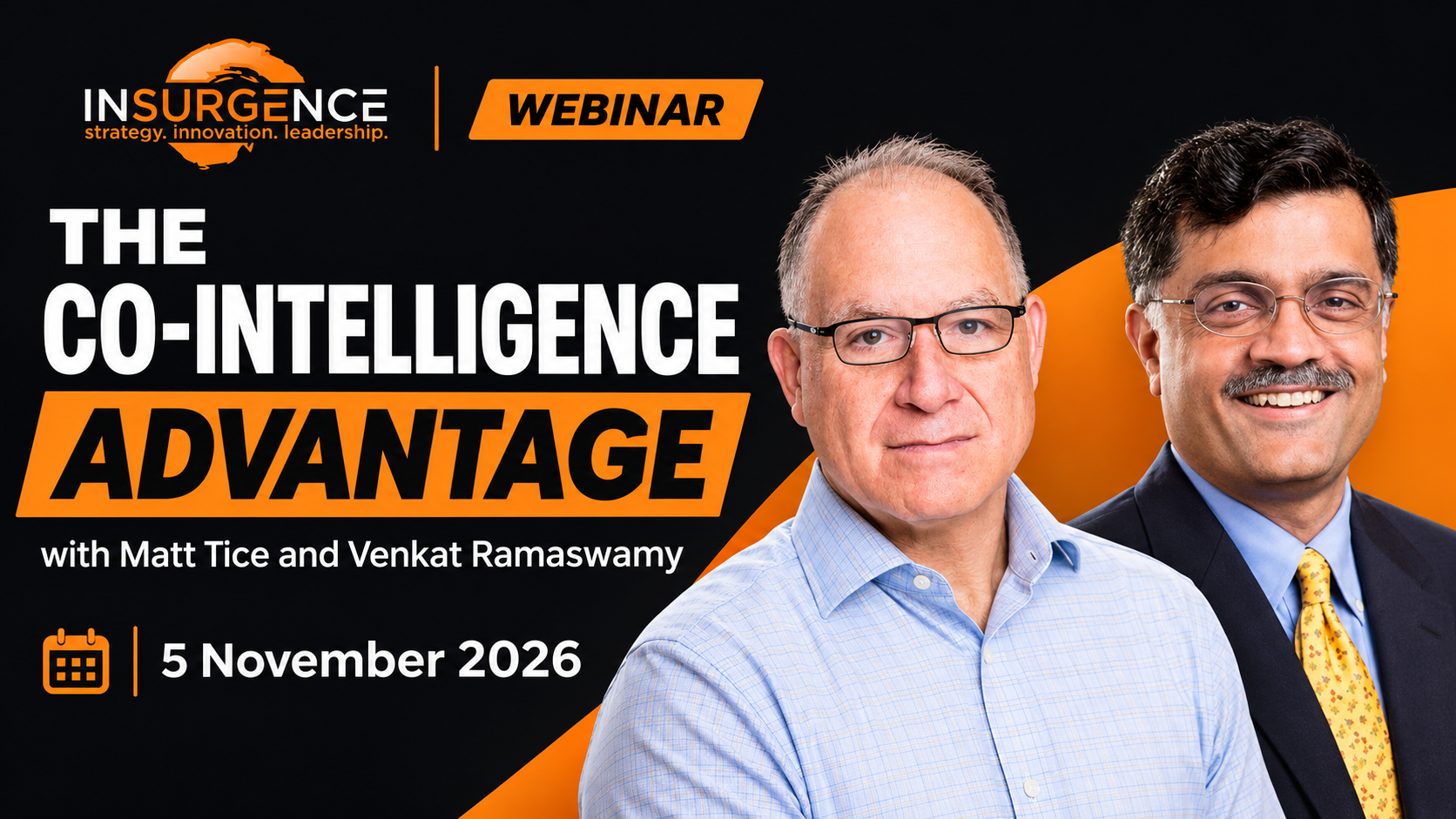
How organisations can combine human judgement, AI capabilities and experience to create a system that can improve through learning from its interactions
With Venkat Ramaswamy and Matt Tice
5th November 2026
Leaders must decide which intelligence to consume from external providers and which distinctive capabilities to develop and retain.
For many organisations, artificial intelligence has become a question of deployment. Which tools should employees use? Which processes can be automated? How quickly can the business generate a return? These are legitimate questions, but they assume that the primary value of AI lies in what the technology can do at the point of use. A more consequential question is whether each interaction makes the organisation better equipped for the next one.
A service technician can use AI to diagnose a fault, complete a repair and close a ticket faster. If the same fault returns three weeks later, however, the apparent productivity gain may have concealed an incomplete diagnosis, a missing piece of context or a poorly executed repair. The real test is whether the organisation can identify what went wrong, validate the lesson and make that knowledge available when the next technician faces a comparable situation. Without that return path, AI may accelerate activity while leaving the underlying capability largely unchanged.
The emerging opportunity is to build organisations in which human expertise, AI systems, customer experience and operational evidence continually inform one another. This requires a broader view of intelligence than software procurement and a more demanding view of learning than collecting data or circulating reports. It also changes where leaders should look for competitive advantage: not only in the intelligence they can access, but in the intelligence their organisations can develop through action. Venkat Ramaswamy develops these ideas with Kris Gopalakrishnan, Krishnan Narayanan and Balaraman Ravindran in their forthcoming book, “Leading Organizational Co-Intelligence,” (LOCI).
From AI-enabled work to an organisational learning cycle
Organisational intelligence begins with the combination of available knowledge, human experience, business context and purpose. People and AI systems then put that intelligence to work through decisions, workflows and interactions with customers, partners and colleagues. Actions, lived experiences of value or harm, and wider consequences leave traces: records of decisions, observations, corrections and feedback. These provide partial evidence of what happened and what it meant to those involved.
The organisation also brings its human and computational capabilities to learning from these traces. AI can help people connect accounts, surface patterns and examine possible explanations. An organisation must interpret what happened, distinguish a useful lesson from a misleading signal, decide what can be trusted and renew the knowledge, judgement, workflows or systems available for future decisions. The cycle runs from intelligence to action, experience, learning and renewed capability. Investment concentrated on the first two stages, such as acquiring models and automating tasks, leaves much of the potential value unrealised.
Consider the recurring service fault. Capturing the repair history is necessary but insufficient, because a record of what happened does not establish why it happened. A technician may need to assess whether the original recommendation was unsuitable for the conditions, whether information was missing or whether execution departed from the intended procedure. Once the lesson has been checked, it can inform the next repair rather than remain trapped in a closed ticket or an individual employee’s memory.
Digital businesses can shorten this cycle because many interactions already occur within systems that capture some traces of actions and consequences. Examples from Anthropic and Canva illustrate organisations seeking to connect experimentation, observed results and the continuous refinement of tools, workflows and practices. The relevant principle is not that every company should operate like a software developer. It is that learning becomes more powerful when the path from experience back into usable capability is deliberate, frequent and accessible.
The LOCI book also discusses Apurva.ai’s work with Ashoka on the New Longevity BrAIn, which helps people draw on knowledge from organisations working on ageing. This illustrates how AI can help connect and examine traces of human activity that need not itself involve AI. What deserves reuse still requires evidence and contextual judgement.
Make the customer experience part of the intelligence system
Traditional businesses often separate customer insight from the functions that could act on it. A service team handles an enquiry, marketing records a preference, operations resolves a complaint and product development receives an occasional summary. Each function may perform its task competently while the organisation fails to recognise what the combined interactions reveal about unmet needs, unreliable recommendations or opportunities to improve the offering itself.
L’Oréal provides an example of how the boundaries can be reconsidered. Its use of AI spans internal creative exploration and consumer-facing product guidance, including tools intended to help people navigate a large range of beauty products. The interaction can offer more than a recommendation. Customer questions, corrections and feedback about whether a recommendation worked can expose the limits of the original advice and provide information that is relevant to future recommendations and product development.
The distinction between a successful interaction and a useful learning system is especially clear when a recommendation fails. A mismatch might reflect an incorrect inference, an overlooked personal preference or a change in the customer’s circumstances. Treating the interaction as finished when the recommendation is delivered prevents the organisation from understanding the difference. Following up, testing interpretations of the response and directing supported learning to the people authorised to act on it can improve both the immediate service and the underlying product. The person contributing that experience should also benefit through clearer guidance or a useful change.
The same principle applies in agriculture, where the consequences of a recommendation depend on local conditions and unfold beyond a digital interface. Land O’Lakes’ Oz assistant brings agricultural knowledge into interactions between agronomists and farmers. The agronomist brings professional judgement to the recommendation, the farmer tests it in the field and subsequent observations can confirm or challenge what the system suggested. Knowledge developed through those encounters can inform later decisions, provided that the organisation has a way to validate and incorporate it.
In both settings, intelligence is distributed across the enterprise and its relationships rather than confined to a model. Customers and partners contribute evidence that the organisation could not generate internally, while employees supply context and judgement that the system cannot assume. The strategic challenge is to connect these contributions without treating every piece of feedback as an established fact.
Govern what the organisation learns
As AI systems become more closely involved in decisions, the quality of organisational learning becomes a management responsibility. A plausible answer is not necessarily a reliable answer, and an observation from one situation may not transfer to another. Organisations therefore need to know which lessons have been tested, the conditions under which they apply and who is accountable for approving their wider use.
In the agricultural example, field observations can contradict an initial recommendation. The appropriate response is neither to discard the system nor to accept its output uncritically. The agronomist and farmer can establish what happened, identify the relevant conditions and determine whether the resulting insight deserves to become reusable knowledge. This form of governed learning combines the speed of digital capture with the discipline of professional validation.
The same discipline applies to service repairs, product recommendations and internal workflows. An organisation should distinguish raw interaction records from interpreted findings, and interpreted findings from approved guidance that remains open to correction. It should also ensure that validated learning reaches the people with the authority to change a product, process or operating practice. A customer insight that remains inside a sales interface cannot improve formulation, engineering or service design unless the organisation deliberately connects those functions.
This is Intelligence Quality Management (IQM): governing quality across the whole cycle, beyond conventional technology risk. Leaders must manage the quality of the intelligence being put to work, the evidence behind it and the consequences of acting on it. Human oversight is not a ceremonial approval step at the end of an automated process. It is part of how organisational knowledge acquires reliability and becomes useful at scale.
Decide which intelligence the enterprise must retain and govern
Access to general-purpose AI can raise the baseline capability of many organisations at once. That makes it useful, but it also limits the extent to which access alone can create differentiation. If competitors can buy comparable tools, an advantage must increasingly come from how those tools are combined with distinctive knowledge, relationships, decisions and operating practices.
The strategic choice is not between building every AI capability internally and relying entirely on external providers. Organisations can consume general-purpose intelligence for activities where differentiation is limited while developing more specific intelligence around capabilities that are central to their value proposition. A manufacturer, distributor or service business may find that its most valuable knowledge sits in how experienced people interpret unusual customer requirements, diagnose recurring problems or coordinate a complex network of partners.
Land O’Lakes illustrates the importance of this boundary. External technology can provide the infrastructure for an intelligence system, while the enterprise develops the context, validated knowledge and interaction practices that make it useful to its own community. The resulting capability is more than a database or a collection of prompts. It is an evolving combination of domain knowledge, judgement, feedback and the means to apply what has been learned.
This choice also creates a commercial tension. External providers may gain value from supplying tools used across many businesses, while individual enterprises need to preserve and develop the capabilities that make them distinctive. The appropriate balance depends on where competitive advantage resides, the investment required to develop distinctive capability and the rights to use, retain and carry learning forward. Treating all AI spending as a single category obscures these very different strategic decisions.
Build the return path into the operating model
For leaders, the practical starting point is not a catalogue of AI applications but an examination of how the organisation learns today. Where do customers, employees and partners encounter problems that recur? What traces of actions, experiences and later consequences become available? Who can interpret them, who can validate a conclusion and how does the result change the next decision? These questions expose gaps that may persist even in organisations with extensive data and sophisticated technology.
A mid-sized business does not need to recreate the infrastructure of a digital platform to begin. A restaurant, for example, can use existing AI tools to help customers understand a menu and make ordering easier. It can also create a more direct way for customers to describe what worked and what did not after a meal. If that feedback is examined alongside staff observations and supports a tested change in kitchen practice or service, the business has started to close the loop between experience and operations rather than merely adding a digital interface.
The organisational requirements are often harder than the technical ones. Employees need permission and practical means to surface errors rather than conceal them. Functional boundaries must allow evidence from one part of the business to influence decisions elsewhere. Leaders must make explicit choices about which lessons are sufficiently reliable to reuse and which require further testing. They also need to resist the temptation to judge success only by the speed or cost of the first interaction when the longer-term value may lie in improving subsequent interactions.
AI expands the capacity to capture signals, retrieve relevant knowledge and bring prior learning into a new situation. Yet the organisation still has to decide what those signals mean, which outcomes matter and how its capabilities should evolve. The enterprises best positioned to benefit will be those that connect intelligence, action and learning into a coherent operating discipline, using external models where they add value while strengthening the knowledge and judgement that make the business distinctive.
As intelligence becomes more abundant, the ability to use it will be necessary but less differentiating. Organisations that can learn from their customers and partners, validate what they discover and mobilise that learning in future decisions have a more durable basis for improvement. Their advantage lies not in completing an AI implementation, but in developing an operating model that becomes more capable through the work it performs.
For more information: mtice@insurgencegroup.com